Tuesday, July 4, 2017

My heart breaks . . .


My orientation to the crisis has involved following around two wonderful Syrian Christian women, Halla and Kifah. Accompanied by our driver, we have made stops all over the region to various "camps." Once there, we talk to mothers about their teenage daughters attending the upcoming trauma camp. We also visit at-risk babies for assessment, cuddle time, and provide support for the mothers.

While calling them camps is technically correct, my assumptions about them are not. I have seen photos of the sprawling city-like camps in Jordan where thousands upon thousands are housed. Here in this region, the camps are numerous but small - sometimes a solo structure or a cluster of 20-30 tents. Most seem to be set in the middle of agricultural patches but some refugees live in crude apartments in the city of Zahle.

Today I was in "tents," simple wood-framed structures covered in tarps. Most serve as single family dwellings but a few house multiple families where up to 20 people live. Water comes from a hose connected to a water barrel. Electricity from a generator. Some have space for small gardens, others are dust bowls. Very few have creature comforts - even chairs are optional. Each has a room for sleeping, a small stove for cooking, and a roof offering protection from the elements. However, everyone seems to have TV hookup. Regardless of the living conditions, which seem universally deplorable to me, it was the stories that broke my heart.

Sometimes I listen with only my eyes and heart because there is no translator. Body language and tone of voice are telling. Other times, I hear parts of the story when someone in the room speaks a bit of English. Of course this helps give context. And on rare occasions, the story is told to me in English where the full impact is experienced and I am able to respond.

Every story is marked by violence. Bombings, destruction and economic devastation are common threads. Family separation and strife are a big part of the pain. Unfortunately, stories of murder have already made the list. And I'm only in my second day here.
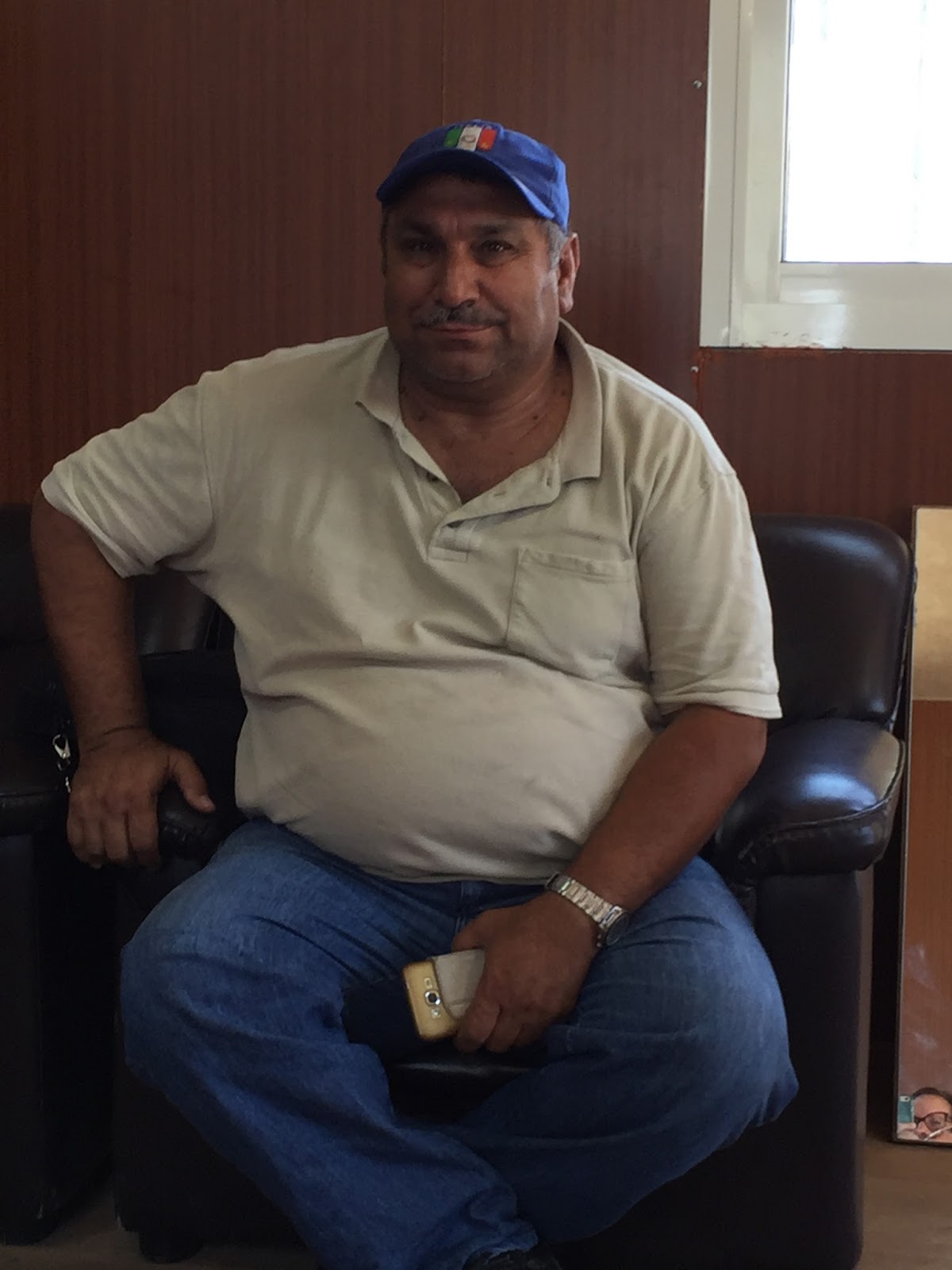
Johnny
Johnny, a man of Syrian Orthodox faith, told me all about his life back home. Prosperous and respected, he lost everything in the ongoing war. As hard as that was to hear, it was the chilling story he told me about an encounter with ISIS that stood out. He and his friends were traveling on a bus when they were stopped by well-armed ISIS soldiers. At gunpoint, everyone was ordered off the bus and told to make shahada or immediate conversion to Islam by saying "There is no god but God. Muhammad is the messenger of God." If they refused, the insurgents told them that they would be killed. He told me that he feared for his life and for the safety of his family. So, although he did not believe it, he said the words and he got back on the bus.  

But the story didn't end there. Johnny told me that one of his friends refused to affirm the prophet as God's messenger and was killed right before his eyes. He is haunted by this image and is racked with guilt because he lacked courage to stand with his friend. Of all the tragedies in his life, this is the one thing that troubles him the most.  

The soul is a tender holding place where memory and shame mingle with faith. There are no easy antidotes in those shadow places. While we tearfully spoke of God's grace and forgiveness, he told me that the image of his friend's murder can never be erased. So he carries that and multiple other wounds around, burdened by guilt, shame and helplessness.    

Even so, he does not let this pain keep him from serving. He volunteers at the local school sponsored by the Baptist church. He lovingly maintains the buildings and grounds. If I heard correctly, he built much of the school himself.  

I detected little pity in the telling of his story. Mostly, he is baffled by the response of the world, the US in particular. He wonders why good and godly people like himself are not given a chance at a new life elsewhere. Even in his helplessness, he reaches out to shape the future for refugee kids by supporting the school's educational efforts. So he questions the indifference of the world to this crisis. If he can play a small part in helping these kids, why don't others? His last question pained me. "Why doesn't America care?"

I didn't have an answer - only an apology and a breaking heart.

A Future with Hope

“For surely I know the plans I have for you, says the Lord, plans for your welfare and not for harm, to give you a future with hope.” Jeremiah 29:11

Before I left Sunnyvale, I gave all my staff and elders a framed gift of Jeremiah 29:11. I thought it was a fitting verse to give to these leaders as they move from the interim period into the future with their new pastor, Hardy Kim. God has been preparing the church for this next season and they seem ready to embrace this next change. The transition will have its challenges to be sure, but the depth of preparation and prayer will ease this next phase in the journey.


So here on my first day in Lebanon, I was again reminded of the power of this verse – a promise that God holds our future. But for Syrian refuges relocating to another part of the world, their faith in God to hold them through this transition may be the essential component that helps them survive.

Izdihar and girls from the trauma camp
Izdihar Kassis, the founder of For the Family, invited Max Lih and me to see first-hand the refuge crisis here in Lebanon. Although there are millions of refugees here, she and her small staff run trauma camps for teens and well-baby care for infants at risk. The scale is small but the impact is life-changing. 

Four years ago, the group reached out to a family that had come from a region in Syria that has been run by ISIS. In terms of religion, this family was part of an extreme Islamic set. When they came to Lebanon, Christians showered them with love and support. The teenage girls attended one of the trauma camps where healing began. Eventually, the entire family put their faith in Christ. Their families back home were not happy. Shunning and threats followed. For safety reasons, the UN is now relocating the family to Norway.

I was invited into their home for final goodbyes and a time of prayer before they left for a country where they know no one, don’t speak the language, and have no community. Everything thing that awaits them there is new including the climate. The only continuity in their lives will be their new-found and deepening faith in Christ.
 a tearful and prayerful goodbye
as the girls and their family move to Noway
I know the plans I have for you . . .
I was struck by contrast between transition the Sunnyvale church is facing and the change this family is facing. I was reminded of the transition that I am about to make to Ohio. In each situation, we are asked to put any anxiety we have about the future into God’s hands. The depth of faith required might be quite different but the God who holds us all is up to the task.

The crisis is enormous, the challenges are overwhelming, and for many, the future is chaotic and uncertain. And yet, the family of faith reaches out and refuses to let despair have the last word. The Christians, many of whom are refuges themselves, are loving and lending aid in Christ’s name. For those who are facing unimaginable odds, it is a concrete expression that God’s plans does involve provision and possibilities.  It may only be a small sliver of hope but their faith encourages them that a small speck is all you need to keep moving forward.

Monday, July 3, 2017

Worship in Reverse

Worship is always a bit of a challenge when it is conducted in a language that you don’t understand. While the songs are often different and the sermon unintelligible, there are still rhythms and rituals that prompt you. If you are open to it, the community, no matter how foreign, can carry you along in their love for God.

The Presbyterian Church in Zahle, Lebanon
It was fitting that this first day in Lebanon began with worship in a Presbyterian Church. Like other Arab Christian congregations I have seen, the men and women sang and prayed with passion. The first song we sang was a standard: How Great Thou Art. While they sang in Arabic, I belted out this familiar hymn in English. The Lord’s Prayer was easy to pick out too. Abana allazy fe al samawat /Our Father who art in heaven . . .

But my favorite moment was when communion was offered. When the bread is broken, the cup shared, we all speak the same language of need and love. The difference was the sweet taste of cardamon that perfumed the bread and the red wine standing in for Christ’s blood.
Try and read the music!
But some differences are jarring. It took me a while to figure out how to find the hymns in the hymnal because while you read Arabic from right to left, the numbers are written like we write them, from left to right. And then when trying to sing, I was completely flummoxed because the musical notation is also written opposite to ours - right to left! Worship in reverse!

Most of us prefer worship in the genres and liturgies we know. We critique and are annoyed when something or someone unfamiliar is unexpectedly introduced. Today, I was distracted by the dissonance and was eager for the end of the service to come. 


The Presbyterian Hymnal in Arabic


I found this curious. I fondly remember worshipping under similar circumstances when I lived in Palestine on sabbatical years ago. I also remember tears streaming down my face when I worshipped with an Arab Christian congregation in Nazareth a year ago. Perhaps the demands and busyness of past few weeks have numbed my soul to the Spirit’s disruptive work. 

Even though I wished for an end to the service, I was also aware of a longing to return. I will have one more Sunday in Lebanon, and two more in Palestine. I expect these other services will serve as further invitations to embrace and enter into the worship at a deeper, non-verbal level.

Psalm 95 prompted me to consider the warning . . . 

O that today you would listen to his voice! Do not harden your hearts, as at Meribah, as on the day at Massah in the wilderness.  vs 7-8
while the beginning of the Psalm spoke the invitation I need to head . . .
O come, let us sing to the Lord; let us make a joyful noise to the rock of our salvation! Let us come into his presence with thanksgiving; let us make a joyful noise to him with songs of praise!  vs 1-2
The true reversal in worship is the one that is needed in me.


-->

Friday, June 30, 2017

Passports, Papers, and People

Today I leave for the Middle East for two weeks in Lebanon working with teenage Syrian refugees and then two weeks in Israel/Palestine for vacation.

A particular challenge around this trip has been the management of travel and passport documents. If you have evidence of travel or entry to Israel on your airline tickets or passport, Lebanon won't let you in. If you show a similar connection to Lebanon, Israel will scrutinize you closely. Traveling in this region often means navigating political, social, and religious boundaries, a situation that foments distrust and hatred.


In my case, the State Department made a mistake on my paperwork and I have spent the better part of this week making multiple calls, filling out duplicate paperwork, befriending my local FedX courier, and making numerous trips to the federal building in San Francisco to rectify the situation. To say this has been aggravating would be an understatement.

When I feel my anger rising at the inconvenience and incompetence, I remind myself about the millions of Syrian refugees who have no documentation and very little possibility of tasting the freedom of movement that the UN Universal Declaration of Human Rights advocates for all people.

The seven-year conflict in Syria has displaced over 50% of population, both within as well as beyond its borders. According to the UN, nearly 12 million Syrians are desperate and in need of humanitarian aid. Just to put that in perspective, that would be the equivalent of the population Ohio, my new home state!

The social toll on host countries like Jordan, Turkey, Iraq, Egypt and Lebanon is staggering. Currently, Lebanon hosts nearly 2 million refugees, a figure that means one in five people living in Lebanon are Syrian refugees. And given the enmity between these two countries, life is fraught for both the refugees and their hosts.

While I grumble and complain about sifting and sorting through the mess the Passport Agency mistakenly created, I am well aware that I have the ability to advocate for a resolution. I have the freedom to jump on a plane and travel to the farthest ends of the earth. I fully expect that I will return to my home country safe and sound.

Most refuges have no such hope. Unaccompanied children and teenagers don’t have the benefit of family, country, culture, or education. Adults have no access to essential paperwork or funds necessary for emigration. Without passports, work permits, or country status, they often become the exploited underclass, living just beyond subsistence levels. For many Syrians, their comfortable middle-class lives have been shattered by the war. For many children, stress, distress, and trauma is only what they know.

As I prepare to leave, I’m trying to wrap my head around this crisis, something that overwhelms me. I feel guilty for not having been more aware of what’s going on. I’m ashamed to say that I have guarded my heart with indifference. I have more in common with the self-important religious person featured in the parable of the Good Samaritan than I care to admit.

I am not hopeful that what I will do there will make much difference in a global perspective. But I do know that it will make a difference in my life.

I want that hard shell surrounding my soul to break apart with stories that stir up compassion and advocacy for the suffering innocents of Syria.

I want these stories to be about people, real people, that I will come to know and care about.

I want these stories to wake us up to their plight and motivate us to respond.

Then perhaps passports and papers as well as the people behind them will motivate us to open our hearts and borders.

-->

Tuesday, June 20, 2017

Love and Leave

"Let them deny themselves, take up the cross, and follow me."  Matthew 16:24

It has been over two years since I left my long-time pastorate in Berkeley to assume an interim senior pastor role at Sunnyvale Presbyterian Church. And now, I am leaving that community for yet another call. 

Love and leave.  

I know this is way of ministry but in the case of Sunnyvale, I didn't anticipate how deeply connected I would feel to the people there. Who would ever have guessed that such a garden of love could be cultivated in 2 short years? How could I have known that first day there that it would hurt so much to leave. 

And yet, even in this overwhelming grief, the horizon is filled with possibilities and a renewed sense of mission. A community in Cincinnati beckons where I know my love for God and God's people will continue to flourish. Mt. Washington Presbyterian Church has already embraced me and I am loving them right back. I'm excited and thrilled for this next step. It is a journey filled with hope and joy and I can't wait to be there.  

Even so, I know from the beginning, this will be another place where I will be called to love and leave. After all, we always take our leave at some point, don't we?

I know that Jesus had to have felt this same grief when he entered into the exhilarating vulnerability of loving his friends and family over 2,000 years ago. Relationships were his currency and he loved deeply and with abandon. So with the cross looming, how did he face that last night in Gethsemane? I ask you, how does one leave when the pain is so intense? Following God's call and command can help. Anticipating future joy can provide perspective.  Pursuing a greater good can produce courage. But even when one has a choice, does it really ease the grief?


Bas-Relief in the Garden of Gethsemane in Jerusalem
When friends are no longer proximate and prayer seems just an internal conversation, when pain is a given and support systems are gone, tears seem like a reasonable response. No wonder Jesus' tears turned blood red.  

Loving and leaving hurts.  

And yet, without Jesus' departure, the disciples would have likely remained an insular, immature bunch. Remember it was Jesus himself who told those same disciples, the ones who would betray and desert him, that they would do even greater works than him.


"Very truly I tell you, whoever believes in me will do the works I have been doing, and they will do even greater things than these, because I am going to the Father."  John 14:12

Loving and leaving - can it really lead to deeper transformation?  

The only way to know is to go forward - embracing the grief and then entering into another set of probabilities and possibilities. What is around the corner will be different but it will be good.  At least that is the hope.   


Love and leave.  I think I can do this. 

Sunday, April 17, 2016

Rivers in the Desert

 I will open rivers on the bare heights,           
     and fountains in the midst of the valleys;    
I will make the wilderness a pool of water,         
    and the dry land springs of water.    
                        ---Isaiah 41:18

Near Mar Saba Monastery


Sitting at brunch on the Bosphorus River in Istanbul, it is difficult to believe that just a few days ago I was in the dry and barren wilderness of the Judean Mountains. Starved of moisture, it's crags and canyons are cracked and cut by scorching sand and wind. 


But today is all about the water. I love the ocean, the river, the sea. I grew up sailing on San Francisco Bay where my earliest memories involve the salty ocean spray on my face. The smell of that kelpy, briny stew are favorite childhood sensations. Not unlike the breaking waves on the California Coast, sitting on the banks of the Bosphorus facilitates a calming peace deep within.


On the way to the Wilderness


So why am I drawn over and over again to inhospitable landscape of the dessert, a place devoid of water, that essential elixir for life?


Of the 14 days I spent in Palestine, I spent parts of four days in the wilderness. All but one visit was a disappointment of sorts. Each trip to the hinterlands offered the possibility to sit, pray, and drink in the spiritual solitude I seem to be chasing and rarely find in my full and freewayed life. But every time I journeyed there, I ended up being welcomed by Bedouins. I guess this is what happens when you befriend folks in the wilderness. Their hospitality invites you to dine, share stories, and drink tea. And when you show up, as I often do with new friends, their kindness cannot be refused. 


Some of the Sunnyvale Group
with Bedouin friends
More Bedouin friends
with Suzanne Brooksbank


So what is it that I am longing for? Sitting beside the Bosphorus River, taking in the magnificent view while sipping a bit of turkish tea comes close to facilitating my need for quiet and reflection. But the vestiges of civilization remain. The pulsing music, the pods of boats, and the sounds of Turks in animated conversation doesn't ameliorate my desire for the deeper communion I had hoped for on this pilgrimage. 

The water beckons and stirs up what the heart holds dear. What I could not physically find in Palestine this round, I now seek in my memory. It is not the waves that call but the feelings of being swallowed up by the sounds of silence within boundless, desolate vistas.

I'm trying to explore what all this means.


Exploring where this will lead


Friday, April 15, 2016

Context

Knowing the context seems to be key in navigating this region of the world. It provides the clues for social interactions, the providence of prevailing political world views, and the framework for meaning making, particularly in the area of religion.

Air Kiss
In Palestine, the greeting among my Christian friends involves an embrace and kissing one another on the cheek. Same for the Bedouins I have met. However an observant Muslim man will never shake the hand of woman who is not part of his family. An ultra-orthodox Jewish man will never even establish eye contact with a woman who is not related to him.  

I am used to the muddled looks on people's faces when responding to their questions about my occupation. With few knowing the meaning of the word pastor or minister, I further confuse them by saying I am a woman priest. "Priest" means a religious leader here but with there is no context for a woman to hold that role.  

So here I am in largely secular city of Istanbul, enjoying dinner with my good friend, Jennifer Reimer who is a professor at a Turkish University. Long into our conversation, our waiter, Emir, interrupted us to ask where we were from and then proceeded to ask more details about our lives.  He totally understood Jenn's profession but could not even begin to wrap his head around mine.  

Priests outside Nativity Church
First, I had to start off with explaining the world Christian. In this Muslim society, he really didn't have any framework for Christian or church. Then it was on to the idea that I am a religious leader. He wondered why I was not veiled. I tried to explain that I was like the Imam of a local mosque but that only blew his mind even more. He went away and chewed on what I had told him for a few minutes before coming back and asking me if I was a virgin. I laughed and told him that I had two children. I think his mind exploded at that moment. We talked more about the nature of God and the differing rules as it relates to religious belief. "Your god OK with alcohol?!!  Mine says alcohol is bad!"  And on it went.

I don't think I have ever been in a situation where a rudimentary understanding of Christian or church is not shared.  It was startling and prodded some late-night musing on what it is like when your core identity and beliefs are completely outside the realm of comprehension by another person.  

I have spent much of my time in the Middle East trying to understand "the other" often taking the role of amateur anthropologist. I work hard to understand the context, customs, and culture of this place.  I ask questions, test my assumptions, and still miss the mark. But rarely have I been the object of such curiosity and miscomprehension.  

It reminds me that context goes both ways. 

Saturday, April 9, 2016

Unexpected Grace

A few weeks ago, an email arrived in my inbox with news that was disappointing and, if I’m honest, hurtful. Our tour operator sent the news that the Catholic Church in Galilee was no longer allowing women pastors to celebrate the sacrament of communion on their sites.

This is not the first time this has happened and I doubt it will be the last. Many in our diverse Christian family won’t allow pastors from other faith traditions celebrate in their holy places. When you add the contentious theological layer of women’s ordination, the prohibition is neither new nor surprising. 

The Mural at Magdala 
What made this particularly painful is the fact that the requested site, Magdala, is dedicated to Mary Magdalene and features the names of key biblical women in the rotunda as you enter. The synagogue-like chapel boasts the dramatic image of the woman with the flow of blood reaching to touch the edge of Jesus’ tunic. What made this surprising is that I have celebrated communion at Magdala on my last three pilgrimages without any problem. The warm welcome I had previously received was now withdrawn.

As we drove up to Magdala, I was aware of a lingering bitterness that comes with unjust exclusion. To my surprise, my friend, Hermana, was there acting as our host. She is a mystic of sorts and her joy buoyed my soul. She encouraged me to write off the prohibition to the old priests that run this place. Even so, I continued to feel the bite of women’s marginalization as we walked the site.

Our next stop was the Local Baptist Church in Nazareth. What a delight to be with this vibrant congregation for Sunday worship. To my surprise, I was asked to spontaneously speak. In all my visits here, I have never been asked to speak in an Arab church. Women pastors are not a category many people understand or accept. You can’t imagine my delight, particularly in light of the earlier visit to Magdala. My heart softened as I knew this was a small sign of God’s validation to me.

Father Justinus

Fast forward to the next day when in Nablus, a conservative city in the northern part of the West Bank, we visited the well where Jesus met the Samaritan woman. This is one of my favorite churches in all of Palestine. Father Justinius, the presiding orthodox priest, built this church and painted all of the icons that adorn the walls. I’m always drawn into the peace of this place and enjoy the many, many icons that feature stories of women in the bible.

Knowing it was against all the rules, I pressed Iyad to ask the priest if we could celebrate there in one of the pocket gardens. My expectations were low but I thought it was worth a shot. When Father Justinius said yes, the caretaker, Jamal, insisted we ask again. He was quite sure that Iyad had misunderstood. And when the good father said yes again, Jamal responded, “A protestant? A woman? This has never happened!”


As I prepared the elements, I sensed an unexpected deep joy rising within. As we began our brief service, we contemplated our deeper thirst that only Christ’s living water can quench. As we shared Christ's sacramental gifts to us, I was overwhelmed by the sense of God's overflowing love for me. Only God could have moved the heart of Father Justinius to make such an unprecedented exception. God’s sweet and tender gift bestowed by this dear Abuna helped me drink deeply from the sweet and clear well of God’s unending grace.


Thursday, April 7, 2016

Returning

Pilgrims have all arrived, a bit bleary-eyed of course. Hours of international travel take their toll. Tel Aviv is a wonderful place to overnight while bodies get acclimated to new times zones, the sounds of new languages, and the look and feel of new money. The beach-front promenade provides a welcoming invitation to move while the Mediterranean itself offers refreshing vitalization to body and soul.

This morning, we officially started the pilgrimage with a time for quiet reflection on the rooftop terrace of our hotel. For some the prayer practice of Lectio Divina is new and I walked the group through the concept of “listening with the ear of your heart,” an invitation that dates back to St. Benedict. I had brought small stone hearts for each pilgrim to carry as a reminder to perceive God’s work through a lens of the inner mystery and communion with God rather than the often narrow perspective of information gathering.

Our verse for the morning was Isaiah 30:15: “In returning and rest you shall be saved; in quietness and in trust shall be your strength.” Lectio invites the selection and lingering on a word or phrase punctuated with spirit-directed silences. As I listened for a word that called to me, the phrase “returning” became the clear focus.

At first, this seemed liked an obvious choice. Here I am in this holy land again, returning to my sacred second home of sorts. Aren’t these pilgrimages all about my need to return to my roots? The taproot of the ancient ways and wisdom are the undercurrent of this place. But I could also imagine that "returning" might be a form of revisiting the political, the invitation to explore the Israeli/Palestinian conflict with more depth. Or was this an invitation to  re-connect with Palestinian friends whose hospitality I find heart-warming and expansive? 

As the day unfolded, I became aware of other returnings and they really had nothing to do with me. Our group itinerary is set well in advance in negotiation with the tour operator and tour guide. Issa and Iyad are my primary conversation partners and I have learned to trust them for the rhythms of the day. Having led these trips for several years, there are places that I prefer to see in a particular order. And, to be honest, there are places that I could bypass altogether. One such place was Mt. Karmel where Elijah slaughtered the 450+ prophets of Bael. I had never been to the church at this site but for some reason, I had decided that I didn’t like it. Iyad suggested lunch on this mountain and so I reluctantly agreed to schedule a visit to this site.

As we arrived in the parking lot, my inner voice was grumbling loudly and I could feel resistance rising. As much as I tried, I was stubbornly fighting with my need to be in control. The church was under construction and we couldn’t go in. The voice inside got even more nasty.  

Then I heard another voice, one that didn’t belong to me. My cousin Doug was singing part of the Elijah oratorio. I was a bit startled and turned to see him responding to this place with wonder.

Up the steps we went and before us was the most beautiful view of the Jereel Valley. From the Galilee to the Sea – it took my breath away.  


As I read the biblical story account, there were tears on Doug’s face. He told me that the Elijah story was one that touched him deeply through the downturns many of us have navigated as pastor/disciples. His honest and transparent joy at being at this site reminded me of another kind of returning. 

Remembering God’s past faithfulness is the most important kind of returning.

I'm glad I'm back.